
Typosquat protection has become a critical security requirement as attackers increasingly exploit small naming variations to deceive users and systems. By registering lookalike domains that closely resemble legitimate brands, threat actors are able to redirect traffic, harvest credentials, distribute malware, and abuse software supply chains.
What was once viewed as a niche brand protection issue is now a core element of modern cyber risk. Without dedicated typosquat protection, organizations expose customers, employees, and developers to threats that operate entirely outside traditional security controls.
What typosquat protection actually covers
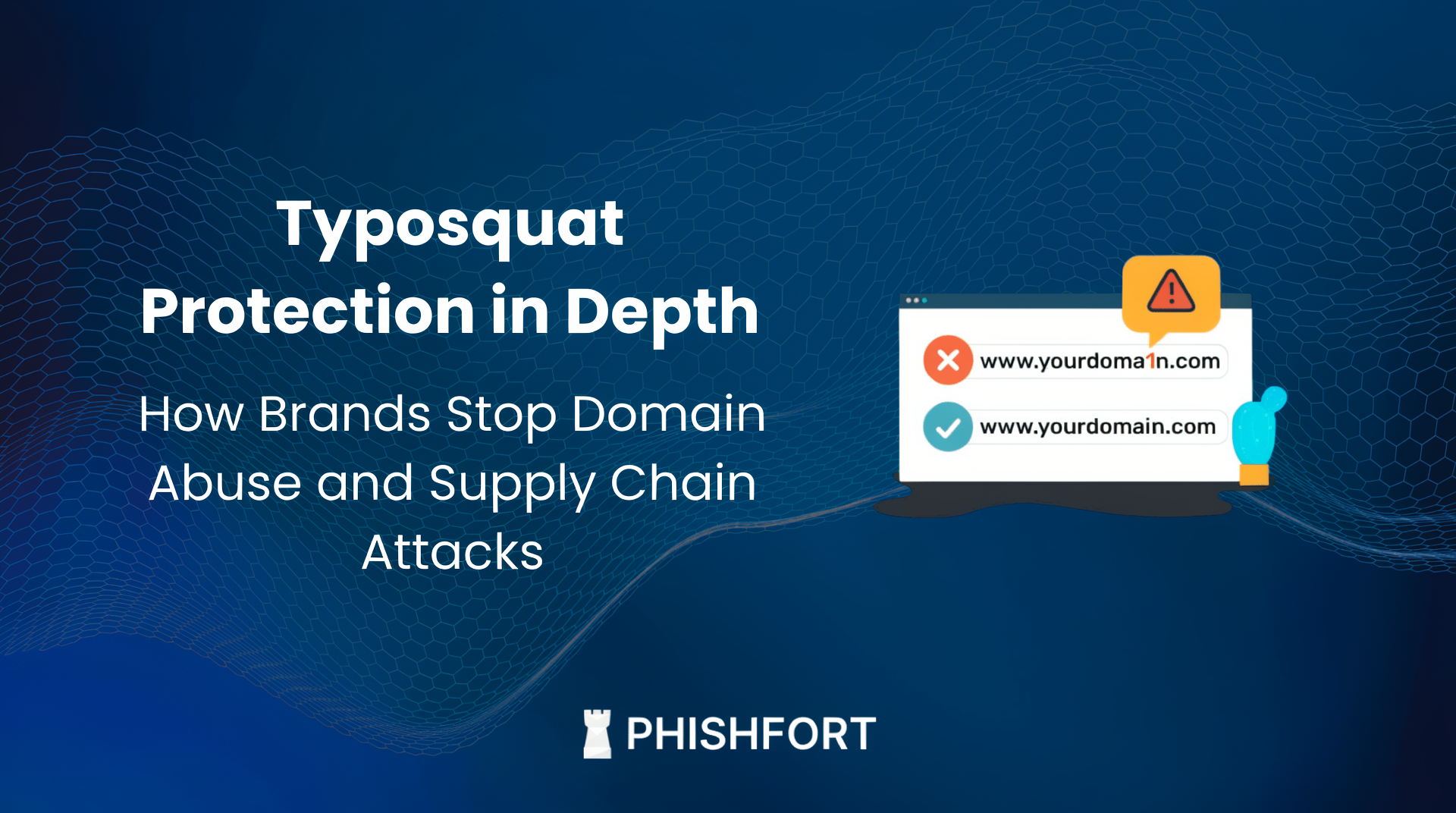
Typosquat protection refers to the continuous discovery, investigation, and mitigation of domains that closely resemble legitimate brand or product domains. These domains are typically created using misspellings, swapped characters, missing letters, homoglyphs, or alternate top-level domains.
Attackers rely on the fact that these differences are subtle and often go unnoticed. A single mistyped character can be enough to redirect a user to a malicious site. Effective typosquat protection focuses on identifying risky domain permutations early, before they are weaponized.
Why typosquatting continues to grow
Typosquatting remains attractive to attackers because domain registration is inexpensive, fast, and scalable. The rapid expansion of new top-level domains has further increased the number of possible lookalike variations available for abuse.
In addition, attackers now combine typosquatting and dependency confusion to target software development workflows. In these cases, malicious domains or packages are intentionally named to resemble internal resources, leading systems to pull attacker-controlled assets by mistake. These dependency confusion attacks extend typosquatting risk beyond phishing into the software supply chain.
Typosquatting as part of the external attack surface
Typosquatting exists entirely outside an organization’s internal network. Firewalls, endpoint protection, and traditional monitoring tools rarely detect these threats until damage has already occurred.
This is why typosquat protection must be treated as part of broader external attack surface management. Continuous visibility into newly registered domains, hosting infrastructure, and usage patterns allows organizations to identify malicious activity early and act before campaigns scale.
Common typosquatting attack scenarios
Phishing and credential harvesting
Attackers use typosquatting domains to host fake login pages that mimic legitimate brand portals. Users are directed to these sites through email, ads, or social media, leading to credential theft.
Malware and traffic redirection
Some typosquatting domains automatically redirect visitors to malicious downloads or ad networks, exposing users to malware and unwanted software.
Software supply chain abuse
Typosquatting is increasingly linked to dependency confusion attacks, where malicious packages or domains are mistaken for internal dependencies during automated builds.
Brand and reputation damage
Even when no direct compromise occurs, typosquatting erodes trust. Users who encounter fake domains often associate the negative experience with the legitimate brand.
How organizations approach typosquat protection
Mature typosquat protection programs begin with continuous monitoring of newly registered domains related to brand keywords, products, and internal naming conventions. This includes permutations, homoglyphs, keyboard proximity errors, and emerging TLDs.
Detection alone is not enough. Organizations must rapidly investigate suspicious domains to determine intent, infrastructure reuse, and campaign relationships. Once malicious intent is confirmed, fast takedown coordination with registrars and hosting providers is essential to reduce exposure time.
Industry research from ICANN explains how the expansion of the domain ecosystem has increased abuse opportunities, while technical analysis from Spamhaus shows that early intervention significantly reduces attacker success rates.
Typosquatting and dependency confusion in practice
Public research from GitHub has documented how dependency confusion attacks exploit naming collisions between public and private packages. This highlights why typosquat protection is relevant not only to security and brand teams, but also to engineering and DevOps.
By monitoring domain and package naming abuse together, organizations can reduce both user-facing fraud and internal supply chain risk.
How PhishFort supports typosquat protection
PhishFort delivers typosquat protection as part of a broader digital risk protection platform. PhishFort continuously monitors global domain registrations and hosting activity to identify lookalike domains that pose a risk to brands or development environments.
The platform combines automated detection with expert-led investigation to validate threats accurately. Once confirmed, coordinated takedown workflows help remove malicious domains quickly, limiting the time attackers can operate.
Typosquat protection integrates naturally with other PhishFort capabilities, including fake domain detection, phishing takedowns, and social media impersonation monitoring. Organizations already using PhishFort’s brand protection services gain expanded visibility into domain-based threats targeting the same assets.
Why typosquat protection is a long-term requirement
Typosquatting is not a one-time issue. Attackers continuously register new variations as brands grow and digital ecosystems expand. Treating typosquat protection as a periodic cleanup leaves organizations exposed between response cycles.
Organizations that invest in continuous typosquat protection are better positioned to prevent and protect users, customers, and internal systems from domain-based attacks. Over time, this reduces fraud, limits supply chain risk, and preserves brand trust.
For additional technical background on typosquatting techniques, Cloudflare provides a detailed overview .
Final perspective on typosquat protection
Typosquat protection has become an essential component of modern cybersecurity and brand defense. By combining continuous monitoring, expert investigation, and fast takedown capabilities, organizations can disrupt domain abuse before it causes real damage.
As attackers continue to exploit scale and automation, proactive typosquat protection remains one of the most effective ways to reduce external risk and protect both users and business operations.